
Agentic Orchestration with A2UI: Establishing the Open Protocol Standard for Autonomous Agent Interfaces
A reference architecture and protocol specification for orchestrating autonomous agents with A2UI (Agent-to-User Interface). Explores the decoupling of streaming transport from declarative presentation, bounded multi-turn deliberation budgets, and the Confirm-Before-Write pattern for zero-trust human-agent collaboration.
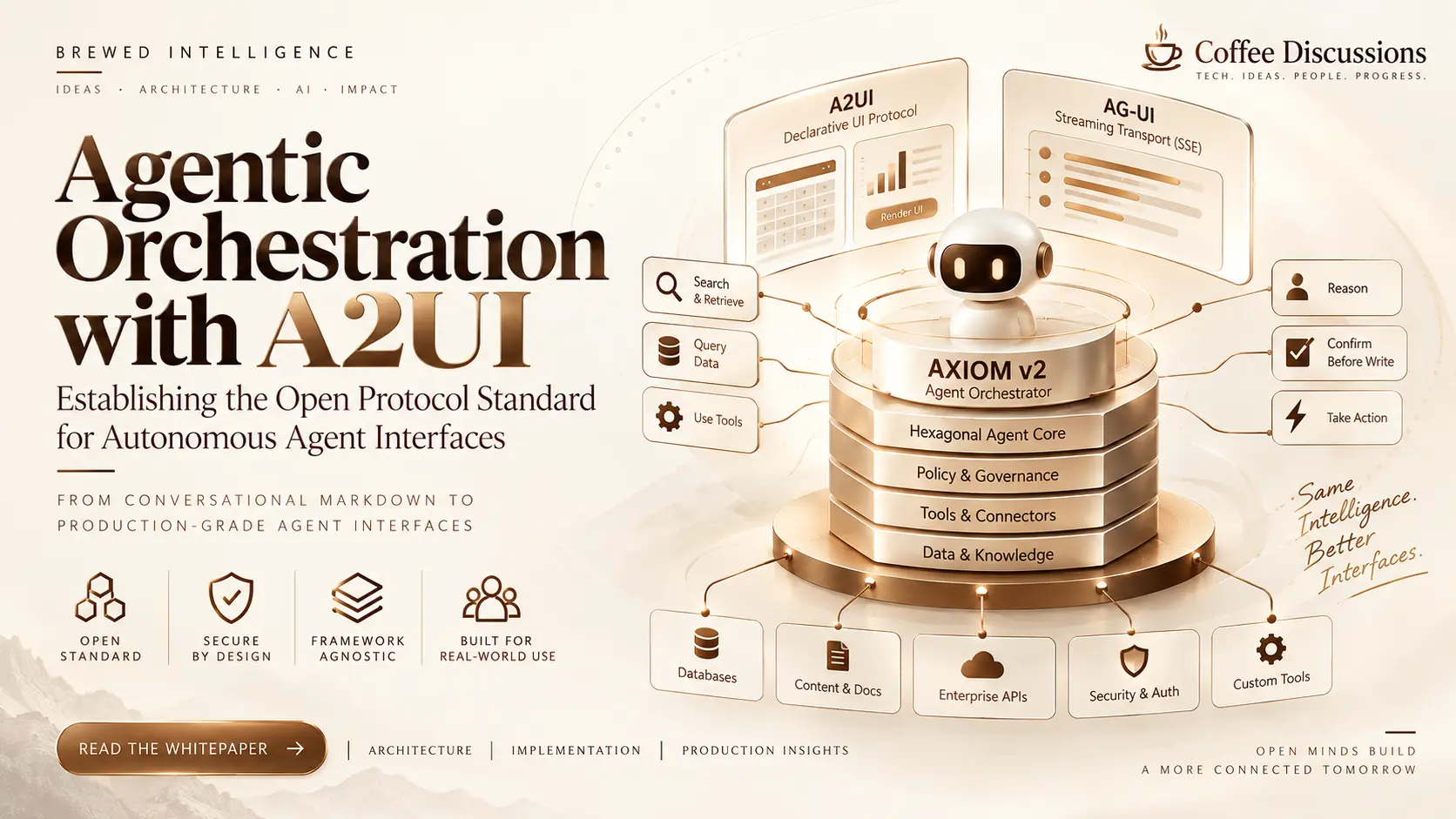
Author: Kuldeep Singh
Role: Chief Architect and AI Systems Engineer
Date: 2026-09-19
Publication: AI Engineering and Systems Architecture
Document Type: Technical Whitepaper and Reference Architecture Specification
Version: v1.0.0 (Production Release)
Standard Status: Open Standard Protocol Specification
Abstract
Modern conversational AI systems have reached a fundamental architectural impasse. While underlying foundation models have advanced from rudimentary text completion to multi-step reasoning, tool execution, and contextual planning, the user presentation tier remains largely trapped in the paradigm of 1990s terminal chat: unstyled prose streams interspersed with detached hyperlink chips. Attempted solutions to this presentation bottleneck have historically bifurcated into two fragile extremes: proprietary, vendor-locked widget libraries or unmanageable sandboxed iframes that introduce severe styling disconnects, security attack surfaces, and mobile rendering penalties.
This whitepaper details the architectural principles, system design, and formal standardization of AXIOM v2 - an enterprise-grade autonomous agent orchestrator powered by A2UI (Agent-to-User Interface), an open, declarative, JSON-driven presentation protocol developed under Apache 2.0. We present an end-to-end reference architecture demonstrating how to orchestrate multi-turn autonomous reasoning loops, policy-gated tools, and dynamic visual surfaces without compromising server-side governance, factual grounding, or client runtime stability.
Key architectural contributions include:
- Decoupling Transport from Presentation: Pairing AG-UI as the streaming transport protocol with A2UI as the structured component and data-binding payload.
- The Hexagonal Deliberation Kernel: Isolating the core reasoning engine behind formal Ports and Adapters, rendering the agent completely agnostic of frontend frameworks, transport layers, and concrete persistence drivers.
- Bounded Multi-Turn Reasoning Budgets: Replacing single-shot completions with a mathematically bounded deliberation budget coupled with progressive on-demand skill injection.
- The Confirm-Before-Write Mutation Pattern: Eliminating unverified side effects through interactive, two-phase confirmation cards routed through an invariant action gateway.
- Zero-Trust Client Rendering: Enforcing a closed component catalog and strict JSON pointer sanitization to neutralize client-side injection vectors.
1. The Presentation Bottleneck: Moving Beyond Conversational Markdown
For the past four years, conversational artificial intelligence has treated human-computer interaction as an append-only sequence of text turns. An incoming user prompt triggers model inference, which streams tokens across a network pipe to be formatted into paragraphs, code blocks, and bullet points via standard markdown parsers.
While sufficient for unstructured creative writing, this paradigm collapses in enterprise and professional engineering contexts:
- Lack of Native Affordances: When an agent analyzes architectural trade-offs, evaluates data schemas, or drafts inquiries, emitting plain prose forces the human reader to mentally reconstruct the underlying structures. Tabular data, interactive charts, and status indicators are flattened into raw text or rigid markdown tables.
- Detached Evidence and Broken Provenance: Citations and grounding sources are typically appended as detached footnotes or floating tags at the bottom of the conversation stream. The semantic link between a specific architectural assertion and its verifying source is severed.
- The State Mutation Hazard: When an agent proposes an action (e.g., dispatching an inquiry, updating a configuration, or committing an order), traditional chat interfaces present a dangerous dichotomy: either the agent executes the mutation autonomously via backend tools without human verification, or it halts and requests permission through conversational text, requiring complex prompt parsing to resume.
- The Iframe Antipattern: Early attempts to embed interactive UI into agents relied on rendering sandboxed HTML iframes emitted by backend tools. In production, iframe architectures destroy layout cohesion, break responsive viewport scaling on mobile devices, prevent uniform accessibility tree generation, and introduce severe Cross-Site Scripting (XSS) attack surfaces.
The A2UI Declarative Imperative
To overcome these structural limitations, modern agent architecture requires a fundamental separation: the agent must emit declarative UI specifications that the client application renders natively using its own pre-compiled design system. Grounding, citations, authorization, and rate governance remain non-negotiable server-owned invariants, while the visual experience matches the responsiveness and ergonomics of a modern web application.
2. The Protocol Landscape: Deconstructing AG-UI, A2UI, and MCP
A frequent point of confusion in modern agent systems is the relationship between emerging interface protocols. Production architectures require a clear mental model of how these standards stack:
| Architectural Tier | Protocol / Layer | Scope and Responsibilities | Core Primitives and Invariants |
|---|---|---|---|
| Tier 1: Presentation | Client Native UI | Host application presentation using native design system tokens | Pre-compiled native components, responsive layouts, accessibility trees |
| Tier 2: UI Protocol | A2UI Protocol | Declarative, model-driven UI schema and reactive data bindings | createSurface, updateComponents, updateDataModel, JSON pointers |
| Tier 3: Transport | AG-UI Protocol | Streaming network transport, sequence tracking, and framing | Typed SSE envelopes (kind: a2ui, kind: error), sequence IDs, heartbeats |
| Tier 4: Orchestrator | Deliberation Kernel | Multi-turn reasoning loops, tool planning, and provenance ledger | Bounded execution budget, skill injector, hexagonal ports boundary |
| Tier 5: Tool Layer | MCP Protocol | Standardized host-to-tool contracts and resource discovery | Server-side tool schemas, resource providers, structured database access |
Protocol Layering Principles
- MCP (Model Context Protocol) is the Backend Nervous System: MCP standardizes how tools, databases, and contextual repositories expose their schemas and capabilities to the agent orchestrator. MCP operates on the server side between the agent runtime and external systems of record.
- AG-UI is the Streaming Transport Pipe: AG-UI defines the framing, sequencing, backpressure, and terminal guarantees of the network stream between the backend orchestrator and the client browser. AG-UI is the pipe; it does not dictate component schemas or visual semantics.
- A2UI is the Declarative Presentation Contract: A2UI defines the declarative layout tree, component bindings, and data model. The agent emits A2UI messages; the client receives these messages and maps them onto its own pre-compiled, trusted component catalog.
Dispelling the Vendor-Lock Myth
A common misconception is that A2UI is tied to a specific foundation model provider. While the specification was spearheaded under Apache 2.0, the wire protocol is pure, prompt-first JSON. Any foundation model capable of adhering to structured JSON schemas (including Claude, GPT, DeepSeek, and open-weights models running via local inference runtimes) can drive an A2UI surface without altering client-side rendering code.
3. Hexagonal Architecture: The Ports and Adapters Foundation
To guarantee long-term maintainability and prevent framework obsolescence, the agentic reasoning kernel must be designed under strict Hexagonal Architecture (Ports and Adapters). The core deliberation engine contains zero references to HTTP transport abstractions, web framework headers, cookies, or concrete database clients.
The Invariant Ports
All environmental dependencies are abstracted behind formal, typed ports:
- Content and Knowledge Port: Governs access to case studies, scholarly articles, architecture domain catalogs, and hybrid retrieval search indices.
- Authentication and Identity Port: Verifies visitor identity, cryptographic session tokens, and enforces rate governance and cost allowances.
- Dialogue and Mutation Port: Handles the lifecycle of state-mutating requests, submission drafts, and transaction confirmations.
- Persistence Port: Provides transactional read and write access to relational and key-value state without coupling the agent to a specific database dialect.
- Configuration Port: Injects runtime model parameters, temperature thresholds, tool quotas, and feature flags.
Decoupling Benefits in Enterprise Systems
By enforcing this boundary, the identical agentic kernel powers three distinct operational environments:
- Public Production Experience: Connected to low-latency Server-Sent Events (SSE) streaming adapters, enforcing public visibility filters, cookie-based session tracking, and IP rate limits.
- Architectural Simulation Workbench: Connected to administrative simulation runners, enabling architects to benchmark prompt profiles, swap embedding models, replay runs, and measure token latency against golden test sets.
- Automated Verification Harnesses: Connected to in-memory mock adapters, executing comprehensive automated test suites in milliseconds without spawning database daemons or network listeners.
4. Multi-Turn Agentic Orchestration: Bounded Iterative Reasoning
Early conversational AI systems relied on single-shot completions: user prompts were assembled with static system instructions, a single retrieval query was executed, and the model streamed its response.
When users pose complex architectural questions (such as evaluating Clean Core implementation patterns against TM Forum ODA event meshes and drafting an inquiry for consultation), single-shot prompt assembly fails. The agent must inspect catalog overviews, retrieve deep case study records, evaluate cross-domain trade-offs, and construct an interactive action card.
The 10-Round Bounded Tool Loop
To achieve deterministic convergence, the orchestrator implements an iterative deliberation loop governed by a strict, finite execution budget:
- Round 0: Initial Inference and Catalog Scoping
The model evaluates user intent, identifies the necessary technical domains, and emits concurrent exploration calls (such as querying domain catalogs and filtering relevant industry records).
- Concurrent Tool Gateway Execution
Pending tool calls are dispatched in parallel under strict per-tool timeout watchdogs (e.g., 8,000ms ceilings). Evidence is extracted, and verified source citations are harvested into an append-only provenance index.
- Round 1: Context Re-Assembly and Deep Retrieval
Observations are folded into the agent's contextual memory using prompt-cache friendly ordering. The model analyzes domain records and requests deep technical specifications for targeted architectures.
- Round 2: Cross-Domain Synthesis and Mutation Preparation
The model synthesizes architectural trade-offs, formulates the comparative analysis, and prepares a structured state mutation draft based on visitor intent.
- Terminal Round: A2UI Surface Emission
The deliberation loop terminates before reaching its maximum round ceiling. The orchestrator emits grounded analytical prose accompanied by an interactive A2UI confirmation surface.
Preventing Infinite Loops and Execution Runaways
To prevent autonomous agents from descending into circular tool-calling spirals or exhausting API budgets, the loop enforces strict invariants:
- Hard Budget Ceiling: Multi-hop reasoning playbooks typically require 3 to 4 rounds. A hard cap of 10 rounds provides ample headroom while guaranteeing bounded execution. On the penultimate round, tool definitions are stripped from the model request, forcing terminal synthesis.
- Concurrent Batching: Tool calls within any single turn are executed concurrently via asynchronous joins with independent timeouts, preventing sequential network latency stacking.
- Progressive Skill Injection: Rather than bloating system prompts with extensive procedural documentation, the orchestrator injects lightweight skill summaries. The agent invokes specialized skill playbooks on demand only when a task requires them.
5. A2UI Protocol Mechanics and Reactivity Pipeline
At the foundation of this presentation architecture is the A2UI protocol. An interaction is governed by three foundational message primitives:
- createSurface: Allocates a unique surface identifier on the client and initializes the root layout container.
- updateComponents: Emits the declarative component hierarchy, specifying structural layout containers (Rows, Columns, Cards) and component properties.
- updateDataModel: Updates the underlying JSON data tree at specific pointer paths without tearing down or recreating the component hierarchy.
Declarative Path Bindings
A2UI decouples component structure from data values using JSON pointers:
- A text block binds its content via a path binding (e.g., path: /answer/body).
- When the agent streams tokens, it emits lightweight data update frames that update the text node in-place.
- The host UI framework re-renders only the bound leaf node, completely eliminating layout reflow jitter and parent container re-mounts.
The Closed Component Catalog
To ensure absolute client-side security and styling consistency, the client runtime operates against a Closed Component Catalog:
- The model cannot emit arbitrary HTML, inline scripts, or unknown CSS styles.
- Every component identifier emitted by the agent must resolve to a vetted, pre-compiled native component (e.g., Typography, CitationCard, MetricCard, CodeBlock, ConfirmationCard, ChartView).
- If the model emits an unknown component type, the client safety engine gracefully falls back to a neutral text representation, logging an audit telemetry event without crashing the host interface.
6. Two-Phase Mutation: The Confirm-Before-Write Pattern
The greatest hazard in agentic systems is the ungoverned execution of state-mutating side effects. When an agent determines that an email should be dispatched, an inquiry submitted, or an infrastructure change applied, it must never execute that mutation solely based on internal model confidence.
 AXIOM A2UI - Brewed Intelligence
AXIOM establishes the Confirm-Before-Write Pattern:
Phase 1: Propose and Synthesize
- Deliberation: The agent determines that a state mutation is warranted and invokes a drafting tool to prepare the proposed payload.
- Surface Synthesis: Rather than executing the mutation, the agent renders an interactive A2UI ConfirmationCard containing:
- A read-only summary of the proposed mutation
- Pre-filled parameters extracted during the dialogue
- An explicit Confirm & Dispatch action button
- A Dismiss action button
Phase 2: Human Verification and Atomic Execution
- Human Inspection: The human user reviews the proposal natively within the client interface and selects Confirm & Dispatch.
- Action Routing: The client dispatches a signed, namespaced action identifier through the hardened action gateway.
- Atomic Commit: The backend verifies cryptographic session authorization, performs the transactional database commit, and dynamically updates the surface to reflect the verified reference identifier.
Architectural Boundary: The model possesses the authority to prepare and present mutations. The final commit remains exclusively authorized by the human operator.
7. Security, Governance and Threat Modeling
Deploying autonomous agents requires defense-in-depth across the entire protocol stack:
Prompt Injection Neutralization
Because A2UI enforces strict structural separation between reasoning tokens and UI layout definitions, adversarial prompts cannot inject executable code into the presentation tier. Model output is treated strictly as data, never as executable instructions for the browser.
URL Protocol Sanitization
All hyperlinks, citations, and action callbacks emitted within A2UI components undergo strict URI scheme validation. Only approved protocols (http, https, mailto) are permitted; dangerous schemes (javascript, data, vbscript) are neutralized into inert text before reaching the DOM.
Cost Governance and Rate Invariants
Autonomous multi-turn deliberation can consume substantial token budgets if left ungoverned. The orchestration kernel enforces strict token allowances, sliding-window rate limits by client identity, and global execution deadlines to ensure predictable operational expenditures.
8. Architectural Lessons from Production
Shipping declarative agentic UI to production yielded critical engineering insights:
- Strict Dependency Export Maps: Modern runtime environments enforce strict module encapsulation. Avoid coupling styling pipelines to third-party vendor CSS imports that may be omitted from package export maps; map declarative protocol primitives directly onto your application's native design tokens.
- React Hook Purity during Streaming: Updating derived UI state inside streaming event handlers without wrapping state transitions can trigger infinite render loops. Always isolate raw network streams from derived visual state.
- Layout Stability during Token Streaming: Streaming incremental text into complex flexbox layouts can induce micro-jitter. Utilizing declarative path bindings to update leaf nodes in-place isolates layout calculations and guarantees smooth visual rendering.
9. Conclusion: The Future of Agentic Interfaces
Conversational AI is transitioning from ephemeral chat bubbles to collaborative, generative software. By combining streaming transport protocols with declarative presentation standards like A2UI, engineering organizations can build autonomous agents that are visually rich, mathematically bounded, and structurally secure.
The A2UI standard proves that we do not need to sacrifice native user experience or enterprise governance to harness the autonomous reasoning power of modern foundation models.
References
- A2UI Specification (v0.9.1+): Open Agent-to-User Interface Protocol Specification, Apache 2.0.
- Model Context Protocol (MCP): Open Standard for AI Model and Tool Integration.
- Hexagonal Architecture: Principles of Ports and Adapters in Modern Systems Engineering.
- TM Forum Open Digital Architecture (ODA): Component Specifications and Event Mesh Standards.
- NIST AI Risk Management Framework: Governance and Human-in-the-Loop Safeguards for Autonomous Systems.
- ▪The Presentation Bottleneck: Why conversational markdown and sandboxed iframes fail enterprise agent requirements.
- ▪The Three-Tier Protocol Stack: Deconstructing the separation between transport (AG-UI), presentation (A2UI), and tools (MCP).
- ▪Hexagonal Deliberation Kernel: Decoupling model reasoning from presentation tiers and backing stores via invariant ports.
- ▪Bounded Deliberation Dynamics: Enforcing mathematical convergence on multi-turn tool loops through hard token and round budgets.
- ▪The Confirm-Before-Write Invariant: Eliminating unreviewed side effects through two-phase declarative state mutations.